Follow me!
Gender Mystique

What's wrong with gender stereotypes?

6/12/2012

 
I read Devan Corneal's defense of gender stereotyping this morning and have been mulling it over all day. Corneal's main argument in defense of gender stereotypes is that she is following her four-year-old son's wishes, not imposing her own. The flaw in basing your beliefs about gender on your four-year-old son or daughter's world view is that it tends to be based more rigidly on stereotypes than at any other time in their lives.

But where is the harm in indulging their four-year-old fantasies about manly men and girly girls? Here's my take:

1. It encourages them to judge others according to those stereotypes. Little kids are the great enforcers of the gender rules as they see them, and they can be downright cruel to kids who don't conform. When your son hears you tell someone he is "all boy", what is he supposed to think of his playmate who isn't just like him?

2. Stereotypes encourage simplistic ways of viewing a complex world. There is a reason humans use stereotypes. They help us make quick decisions in confusing or chaotic situations. But quick decisions are not always the right ones. Which serves your child better in learning to get along with other people: simple thinking or complex thinking?

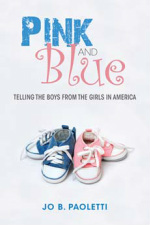
3. Many of our gender stereotypes are superficial, arbitrary and subject to change. (This is the main point of my book, Pink and Blue.) Boys 100 years ago wore pink and played with dolls. Legos used to be unisex. Field hockey is a man's game in India. Elevating stereotypes to the level of natural law is, well, silly.

4. Stereotypes depend on our believing that sex and gender are binary (either-or). To summarize the last 50 years of research on the subject, they are not. There are babies born everyday who are not clearly boys or girls on the outside, and our insides -- physical, mental and emotional -- comprise an infinite range of gender identity and expressions.

Stereotypes may be cute in a four-year-old, but think of the stereotypes of teenagers, adults and elders we see in our media. How do we feel about those? Are we equally ok with our children believing in racial stereotypes? Before you let your child embrace a stereotype, think it through.
Liz Sweet
6/12/2012 10:04:33 am

Thank you so much for this thoughtful response to that article. I just read it and found myself so frustrated after doing so, but I didn't have the wherewithal to articulate such a nice critique.

I think the most frustrating thing about such arguments is that they do assume that gender stereotypes are (a) based in biological fact and (b) static and consistent over time. Thus we are told we should not only be untroubled by them, but we should embrace them. What I love about your book, among other things, is that you use cultural artifacts to make the case that these stereotypes and norms are not fixed and biologically determined, but rather are fluid and culturally shaped. Thank you for that!

Alice
6/15/2012 06:43:23 am

I've enjoyed your post here, but my comment is that I didn't view the Corneal post as defending gender stereotyping, nor did I take from it that she encourages her 4-yo to run with any "manly men" or "girly girl" ideas. I'm not sure that you two are exactly on the same page, but I'm thinking you two are closer than you think?

Ali
6/16/2012 12:06:58 pm

So i completely agree with this article, and i find it hard to deal with the rest of the world putting these stereotypes on my son... especially my in-laws. What do you say though, to the deeply entrenched MIL, or the BIL?
We have been given shirts which read "ladies man" and "chick magnet" and they make comments like "he is a real little boy" and "you are such a boy now" that i just want to put him in a pink dress and stockings and get a shirt that says "when i grow up i want to be a cross-dresser" but they would they say im "turning him gay" and other such stupidity. I feel like there is no getting thru to them!

Jo
6/17/2012 01:13:48 am

My favorite words of wisdom from my own mother are "pick your battles". Ironically, I had the same problem you describe with her! She lived nearby, so it was pretty constant, especially since she knew my opinions on gender stereotyping.

Some of her remarks and actions were meant to tease me, and those I ignored, or teased her back, depending on the situation. But often it was just inadvertent, or her choice of words not being what I would have said. So if she said "You are such a boy", I would say, "You remind me of Uncle Bob when he was little" and ask Mom if she remembered my brother doing the same thing. The gender stereotyped outfits for the kids were seldom worn, except for pictures sent to the givers. I spent one day photographing my 3-month-old daughter in every frilly dress she owned, sent copies to the friends and family who gave them to her. Then I packed most of them off to the thrift store.

The "all boy" or "boys will be boys" phrases are so common that I really had to pick my battles with those! In truth, they bothered me for different reasons as well. I usually let it slide if he wasn't in earshot. If her heard the comment, I would wait until he wasn't and remind her that ____ (fill in the blank for my objection). I would also try to balance her comments by de-gendering them. I mean praising my son for his good qualities because they were good qualities, not because they we're "boy" qualities. I also mean correcting bad behavior because it was bad behavior, not excusing it because it was "boy" behavior. I had a very pointed talk with my son's Cub Scout den once about how "boys will be boys" was an insult, because it was a way of saying they weren't capable of better behavior.

I have no idea if any of this had anything to do with my son's becoming the young man he is today. But it made life with Mom a little easier.

How have other readers handled this issue?

Eliza link
6/26/2012 12:46:33 pm

I've had my share of thoughtless comments aimed at my sons - the younger of whom is 6 months, and pretty much a smiley blob of baby-poodge and giggles; the older of whom is nearly three and not as boyish as people would like him to be. Long curly hair and delicate features: it cracks me up when people say, "He's all boy", because I know that's all in their heads. Still: if he's in earshot, we talk about what it is to be a boy or a girl, and then I play "Free to Be You and Me" for a few days.

As for the gender typing in a four-year-old, my first response is this: since when do we let our four-year-olds make decisions like that? Don't we enforce good behavior, and try to curtail behaviors that might harm or disparage others?

My long-haired son wears lots of shirts with construction vehicles, which are a passion for him. I don't consider this conforming to stereotype, since the shirts' message is never prescriptive. I will not, however, let him wear such messages - the "boys will be boys" or "little man" or "tough guy" shirts, even if they have the ever-tempting excavator on them. He may make certain choices for himself, as long as he is comfortable in his skin. Others, I will make for him - the ones that might make others uncomfortable in their own skins, by reinforcing harmfully-rigid gender types, for instance.

Just my own take.

Christopher
4/12/2015 04:12:18 pm

I love what this article has to say in general about a lot of topics! :) Thanks for sharing you amazing human!

Jo
4/13/2015 12:22:04 am

Thanks for the kind words, Christopher! Is it just my wishful thinking, or does it feel like a change is underway?

David
2/15/2016 08:15:04 pm

I was disappointed with this article.

To be clear, I agree with all the values that are espoused here. I'm very progressive.

But the article seems to suggest that we should try to engender in our four-year-old's a level of complexity of thought that remains beyond many adults. That's even more silly than calling pink a biologically feminine color.

Sadly, it appears that the author didn't read Corneal's article in full, but skimmed through or ignored the rest of the article after reading the first couple paragraphs. I think Corneal's approach to child rearing is spot on.

For one thing, as several commenters have observed, trying to keep your child from learning about gender stereotypes is an exercise in futility. It’s also not harmful.

What is harmful? Trying to steer your child’s gender identity or gender expression. in any direction. Corneal's approach to raising her kid is the healthiest approach.

Why?

Because if you discourage a child from embracing their gender role for fear that they're being too stereotypical, you're doing exactly as much damage to the child as if you discourage them from embracing the opposite gender role. In either case, your child will perceive you as judging them for doing something wrong when all they're doing is expressing themselves.

Lifelong damage isn't caused by encouraging a boy to be masculine or a girl to be feminine. Lifelong damage is caused by discouraging a child from expressing their true selves. Preventing a boy from expressing masculinity is just as damaging as preventing a boy from expressing femininity. Ditto girls and hermaphrodites.

Being truly open to your child's gender development means being truly open to it without ANY judgment, even if it happens to develop in a stereotypical direction, even if that's not what you'd prefer. Preventing gender expression in the name of progressive values is no less damaging than preventing gender expression in the name of conservative values.

Watch the movie "Trans" for more insight into this complex topic. Your kid's not going to be damaged by learning about gender stereotypes. And learning about stereotypes isn't going to stop your kid from figuring it out if there's a mismatch. Damage comes from lack of support and acceptance of whatever gender your kid is or isn't expressing on any given day.


Comments are closed.

    Jo Paoletti

    Professor Emerita
    ​American Studies
    University of Maryland

    Picture
    Picture

    Archives

    January 2023
    February 2022
    May 2021
    June 2020
    February 2020
    August 2019
    July 2019
    June 2019
    April 2019
    March 2019
    December 2018
    November 2018
    October 2018
    August 2018
    July 2018
    February 2018
    October 2017
    September 2017
    August 2017
    June 2017
    March 2017
    February 2017
    November 2016
    October 2016
    September 2016
    August 2016
    June 2016
    March 2016
    January 2016
    December 2015
    November 2015
    August 2015
    May 2015
    April 2015
    March 2015
    November 2014
    October 2014
    September 2014
    July 2014
    June 2014
    April 2014
    March 2014
    February 2014
    January 2014
    August 2013
    July 2013
    June 2013
    May 2013
    March 2013
    February 2013
    January 2013
    December 2012
    September 2012
    August 2012
    June 2012
    May 2012
    April 2012
    March 2012
    February 2012
    January 2012
    December 2011
    November 2011
    October 2011
    September 2011
    June 2011
    April 2011
    March 2011
    February 2011
    September 2010
    August 2010
    July 2010

    Categories

    All
    1920s
    1950s
    1960s
    1970s
    1980s
    Aging
    Ask Jo
    Baby Cards
    Baby Clothes
    Baby Dresses
    Beyond The Us
    Book 1
    Book 2
    Book 3
    Boys
    Button On Suit
    Button-on Suit
    Child Consumers
    Children And Consumers
    Children As Consumers
    Color Symbolism
    Creepers
    Culture Wars
    Design Details
    Dress Codes
    Dress Up Play
    Dress-up Play
    Ethnicity
    Fashion And Age
    Feminism
    Garment Details
    Gender Binary
    Girls
    Hair
    Layettes
    Men
    Middle Childhood
    Neutral
    Pants For Girls
    Pink
    Pink For Boys
    Prenatal Testing
    Princesses
    Que Sera Sera
    Rants
    Research
    Rompers
    Sexuality
    Stereotypes
    Teens
    Toddlers
    Tomboys
    Transgender
    Unisex
    Unisex. 1970s
    Women
    Writing Updates

Powered by Create your own unique website with customizable templates.